
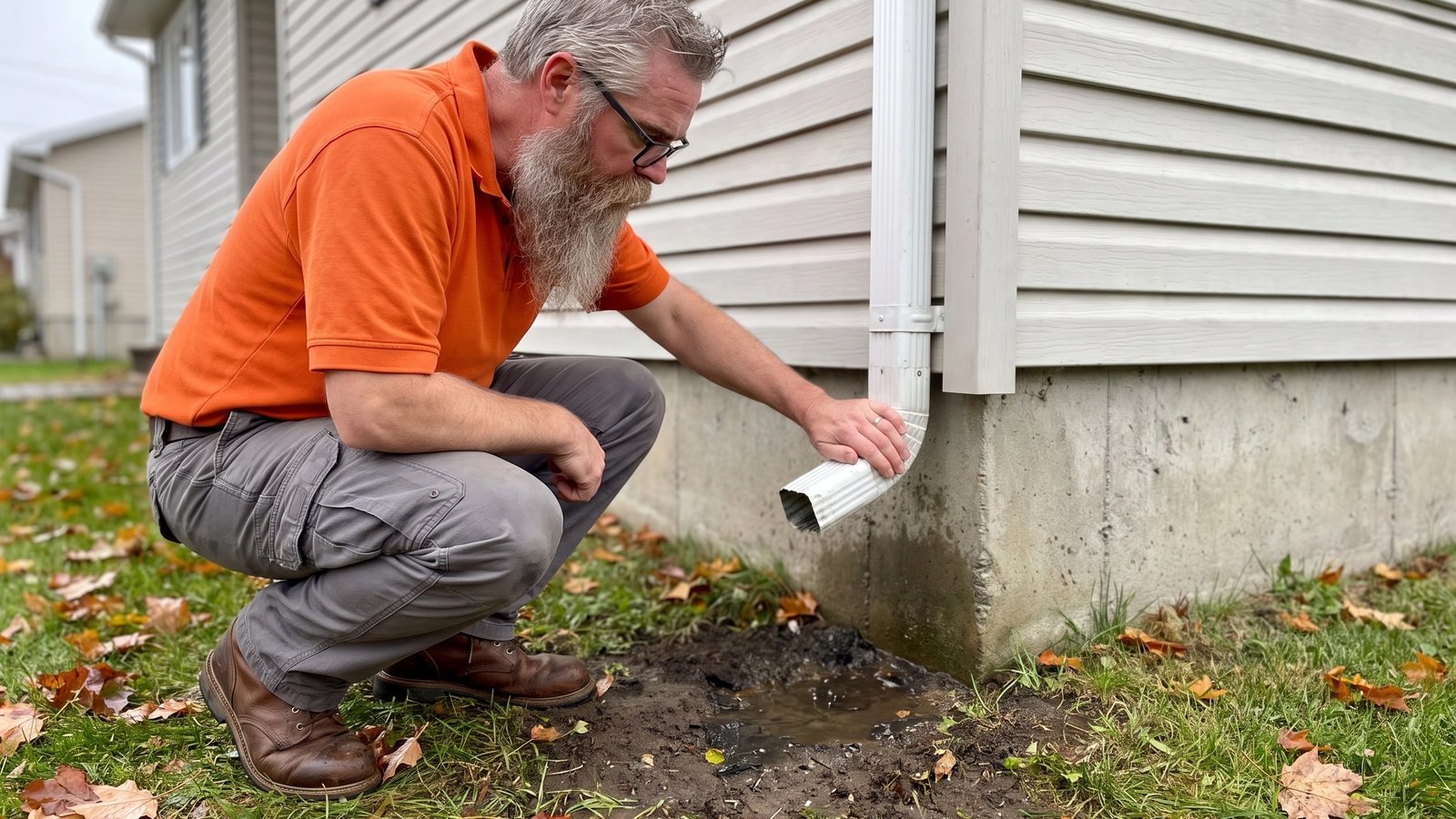
In one stretch of two weeks this past March, I inspected three houses in Quispamsis: two established homes on settled streets and one brand new build waiting on its landscaping. Different decades, different buyers, different price points. All three reports carried the same note in the exterior section, and it was not about the roof or the wiring. It was about where the water goes when it comes off the roof. One home had no gutter on the porch roof and downspouts ending at the foundation everywhere else. One had downspouts that vanished into the ground with no way to tell where they came out. The new build had rough grading, a pile of construction debris, and a downspout at the wall on one side. Nothing dramatic in any of them, and all three fixable for less than a weekend at Costco.
Quick Answer
Water management around a house comes down to two distances, and both are 1.8 metres, or six feet. The ground should slope away from the foundation for at least six feet, and every downspout should discharge at least six feet from the wall. That guidance comes from Canada Mortgage and Housing Corporation and the City of Saint John gives the same two numbers. Downspout extensions cost a few dollars each. Regrading around a house is usually a few thousand dollars. A new exterior weeping tile and waterproofing job in New Brunswick runs $8,000 to $15,000 for a typical home. Almost everyone should start at the cheap end.
Why Fall Is the Season for This
Environment Canada’s climate normals for the Saint John airport put annual precipitation at 1,271 millimetres, with 1,073 millimetres of it falling as rain. It does not arrive evenly. October averages 138 millimetres and November 138 millimetres, the two heaviest months on the chart, and they land when the ground is already wet from September and the leaves are in the gutters. Then 215 centimetres of snow sits against the house until March and melts in a hurry.
The ground under us does not help much. The provincial soil survey classes the Quispamsis series, the soil under much of the Kennebecasis Valley, as imperfectly drained, and heavy clay subsoils are common across the province. Clay holds water against a foundation instead of letting it pass. A house on a bedrock knob in Saint John has the opposite problem: nowhere for water to go but sideways, toward the basement.
None of this is a reason to worry. It is a reason to spend an hour outside with a level before the rain arrives.
The Six Foot Rule
The National Building Code, which New Brunswick adopts under its Building Code Administration Act, keeps the requirement simple: the site must be graded so that water does not accumulate at or near the building. Builders’ guidance on that clause calls for a minimum two percent slope away from the house, carried past the backfill zone, because the soil put back around a new foundation settles for years and turns into a shallow trough against the wall.
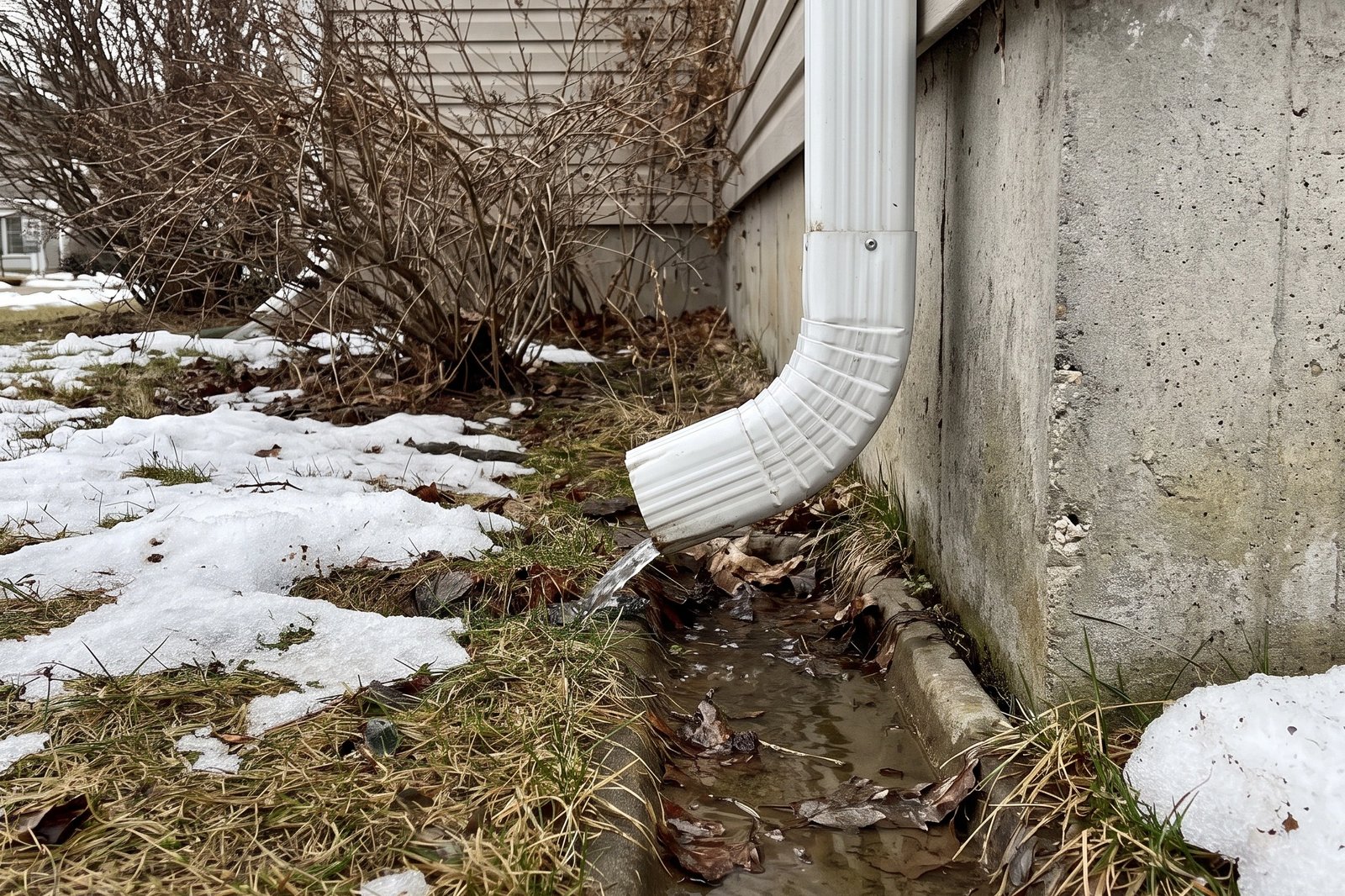
CMHC and the City of Saint John turn that into two numbers anyone can check with a tape measure. The land should slope away from the house for at least 1.8 metres. Every downspout should extend at least 1.8 metres from the basement wall and drain toward the street, a swale, or the back yard, never toward the neighbour. If a downspout is connected to the weeping tile or the sewer, the City’s advice is to disconnect it, because roof water sent straight into the weeping tile overloads the one system meant to keep the basement dry. A sump pump discharge gets the same six feet, and the code keeps dry wells at least five metres from the foundation.
| What I see outside | What it usually means | The next step |
|---|---|---|
| Downspout ending at the foundation | Roof water soaking the soil against the wall | A six foot extension or a splash block, this weekend |
| Downspout disappearing below grade | An underground drain of unknown condition | Ask where it ends, then watch it in a hard rain |
| A shallow trench along the wall | Backfill has settled and now holds water | Add fill and slope it away, two percent or better |
| Window well full of leaves or soil | The well is collecting water instead of shedding it | Clean it, add gravel, fit a cover |
| Mulch or soil above the siding line | Moisture held against wood and sheathing | Pull the bed back and lower it |
| White staining on the basement wall inside | Water passing through and evaporating | Fix the outside first, then watch it for a season |
Downspouts That Disappear Underground
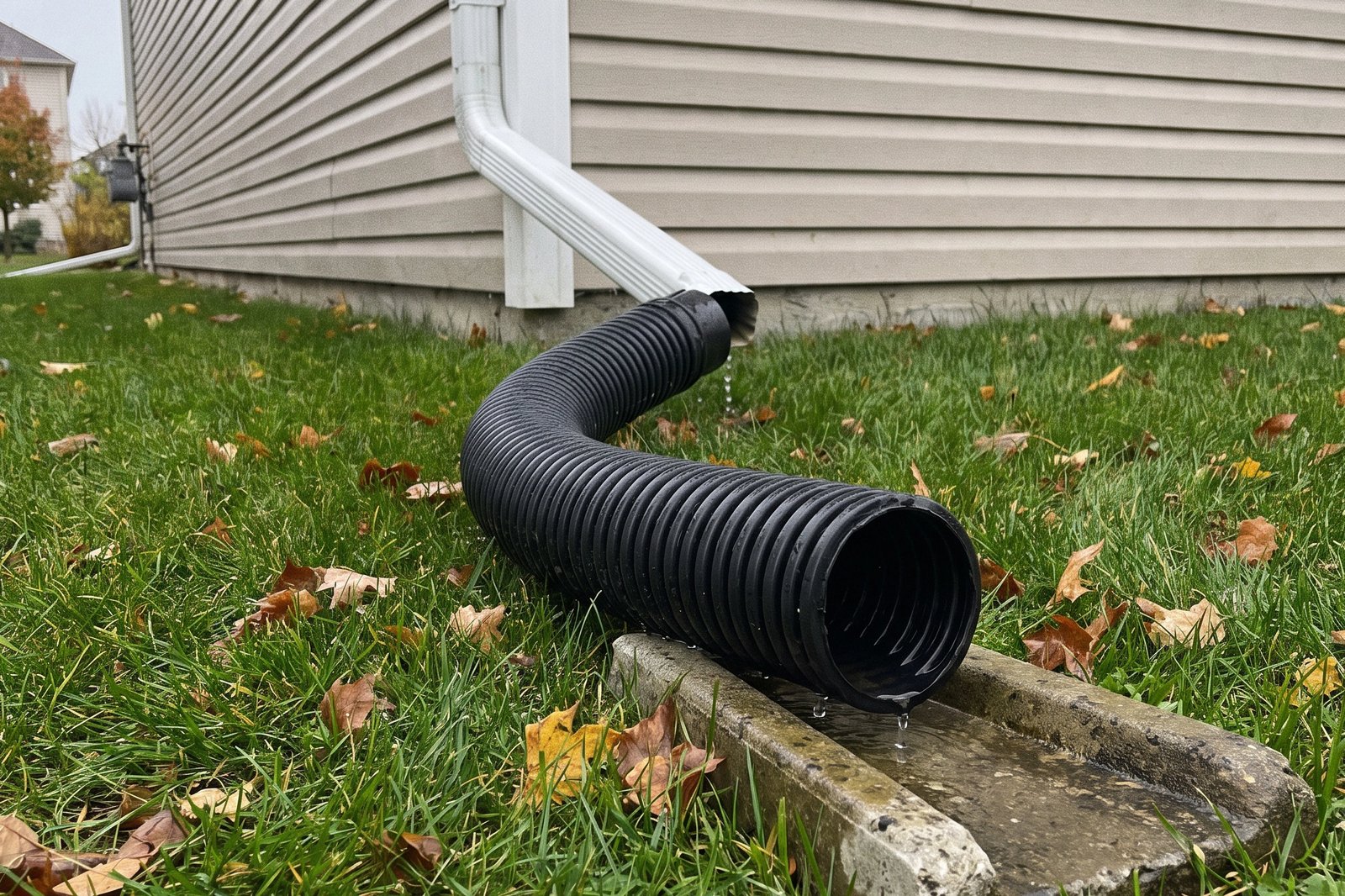
Buried downspout drains are common on newer homes in Rothesay and Quispamsis, and on plenty of older ones where an owner got tired of extensions across the lawn. When they work, they are the best solution on this page. The catch is that I cannot see where they go. A home inspection is visual, and CAHPI’s standards ask me to inspect grading and surface drainage, not to trace buried pipe. So my report says what it can: some downspouts terminate below grade, the termination point could not be confirmed, ask the seller.
The follow up is something anyone can do. A couple of times a year, and always in the first big fall storm, stand at the downspout and watch. Water going down the pipe is a system that works. Water bubbling back up at the connection means the line is blocked, crushed, or frozen, and the roof is now draining exactly where the pipe was meant to prevent. Sometimes the answer is simply to disconnect it and go back to an extension.
New Builds: Rough Grading Is Normal, Finished Grading Is Yours
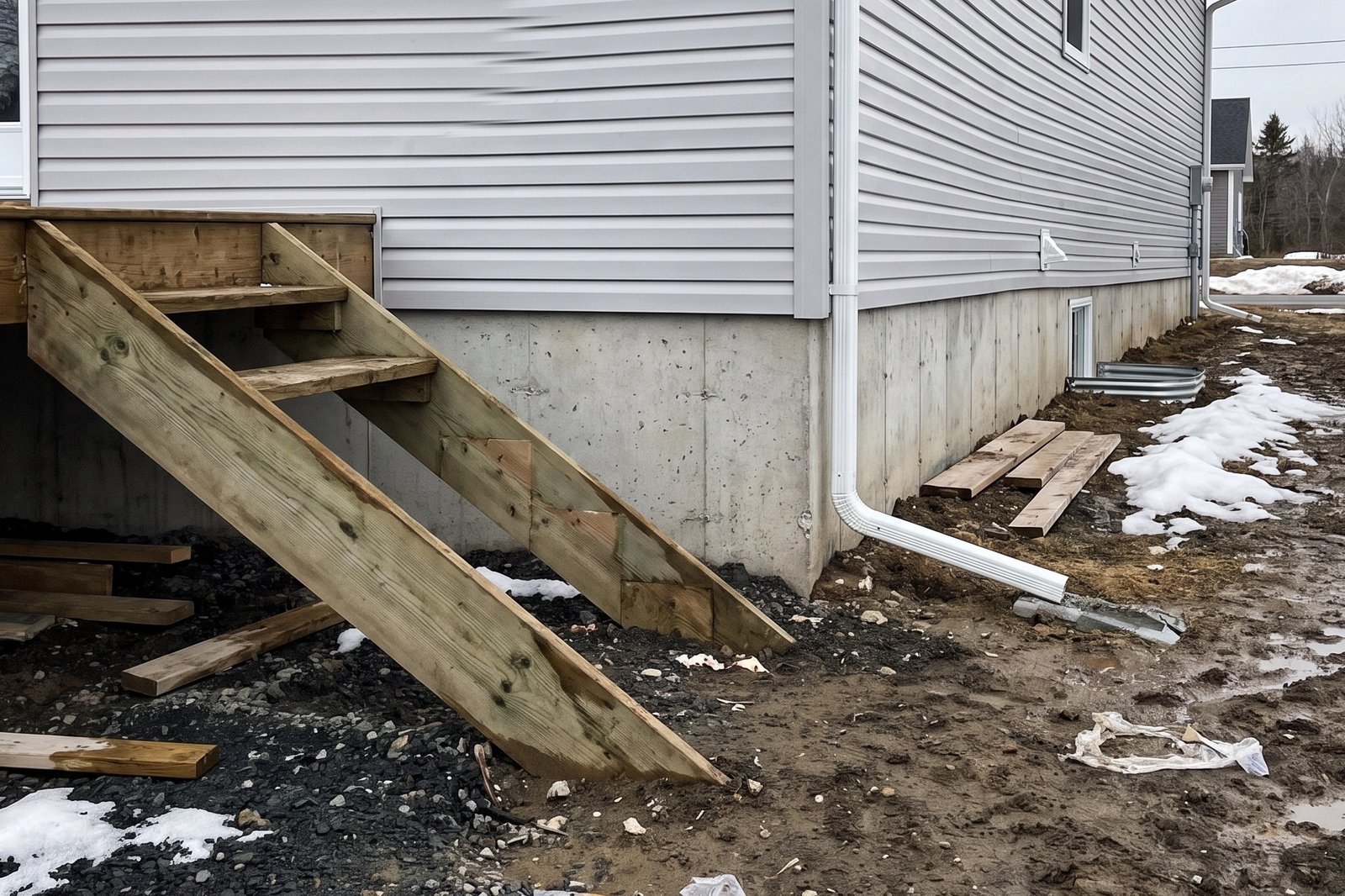
Most new houses in the Kennebecasis Valley are handed over with construction grade fill around them. That is not a shortcut. Final grading waits for the excavator to leave and the backfill to settle. The trap is the order of operations. If the walkway, front steps, and landings go in first and the sod arrives after, the finished grade can end up higher than the hard surfaces, which sends water toward the house and leaves the bottom step below the soil. On the March new build, that is exactly what I found, along with construction debris that needed to leave before anyone brought in topsoil.
If you are buying new, ask the builder three plain questions before closing: where do the below grade drains end, who does the finished grading, and when. A new construction inspection puts those answers in writing while the builder is still on site.
What the Fixes Cost, Cheapest First
| Fix | Typical cost | When it is the right one |
|---|---|---|
| Downspout extensions and splash blocks | A few dollars each in materials | Always first. Most wet basements I see start here |
| Cleaning and repairing gutters | An afternoon, or a few hundred dollars for a crew | Overflowing gutters make every other fix pointless |
| Regrading around the house | A few thousand dollars for fill and a small machine | Settled backfill, a lot sloping toward the house |
| Sump pump and pit | $1,200 to $3,500 in New Brunswick | Water still arriving after the outside is right |
| Interior drain along the basement floor to a sump | Quoted case by case, usually well under exterior work | Finished basements where digging outside is not practical |
| Exterior weeping tile and waterproofing | $8,000 to $15,000 for a typical New Brunswick home, $12,000 to $18,000 with a sump and regrading | Failed or missing weeping tile, chronic water at the footing |
The exterior number is the one that gets quoted first and needed last. In New Brunswick, excavation is close to half the price because of frost depth and clay, and Canadian cost guides put a full exterior drain replacement at $100 to $250 per linear foot. Before anyone digs, the six foot rule should be in place and watched through at least one wet season.
What I Actually Check
CAHPI’s National Standards of Practice put grading and surface drainage on the exterior list alongside walkways, retaining walls, and window wells. I walk the outside looking at the slope in the first six feet, where every downspout ends, whether the gutters are complete and clear, and where a sump pump discharges. Inside, I look at the foundation walls for staining, efflorescence, and the tide line a spring puddle leaves behind.
What I cannot do is make it rain. If the day is dry, I say so in the report, because a drainage system can only be judged in weather. That is why so many of my exterior notes end the same way: watch it through a season, and call me if what you see does not match what I wrote.
Buying a home before the fall rain?
I inspect the grading, gutters, downspouts, and foundation on every home across Southern New Brunswick, and I will tell you plainly what needs an extension and what needs an excavator, before you close.
Find My PackageFrequently Asked Questions
How far should downspouts extend from the house?
At least 1.8 metres, or six feet, from the foundation wall, onto ground that slopes away from the house. That is the CMHC figure and the City of Saint John’s figure. Farther is better on clay.
Is water in the basement normal in New Brunswick in the spring?
A damp corner after the March melt is common in older homes here, and it usually traces back outside: a downspout at the wall, settled grading, or snow piled against the foundation. Standing water is different. Either way, start with the six foot rule and watch through a season before spending on drains.
Does a home inspection check the weeping tile?
Not directly. Weeping tile is buried at the footing and a home inspection is visual and non invasive. I check the grading, the downspouts, the sump if there is one, and the inside of the foundation for evidence of water. If a buried drain is in question, a drain contractor can scope it, the same way a sewer scope looks at the line to the street.
Should my downspouts connect to the weeping tile or the sewer?
No. The City of Saint John asks homeowners to disconnect downspouts from the weeping tile and extend them six feet from the wall, because roof water is the fastest way to overload a foundation drain. The City also recommends a backwater valve on the sanitary line to reduce the chance of a sewer backup in a storm. On homes with a septic system in Hampton or Sussex, roof water should never reach the septic field.
Do I need a sump pump?
Only if water still arrives after the outside is right. A sump pump and pit runs $1,200 to $3,500 in New Brunswick, and it is a good tool for a house that sits low or on clay. It is a poor substitute for a downspout extension, and I see plenty of pumps working hard to remove water that six feet of extension would have kept out in the first place.
The short version: the ground should fall away from the house for six feet, every downspout should end six feet from the wall, and the buried ones deserve a look in the rain. If you are buying a home this fall in Southern New Brunswick, book your inspection at theinspectors.ca or call or text (506) 651-9461.