
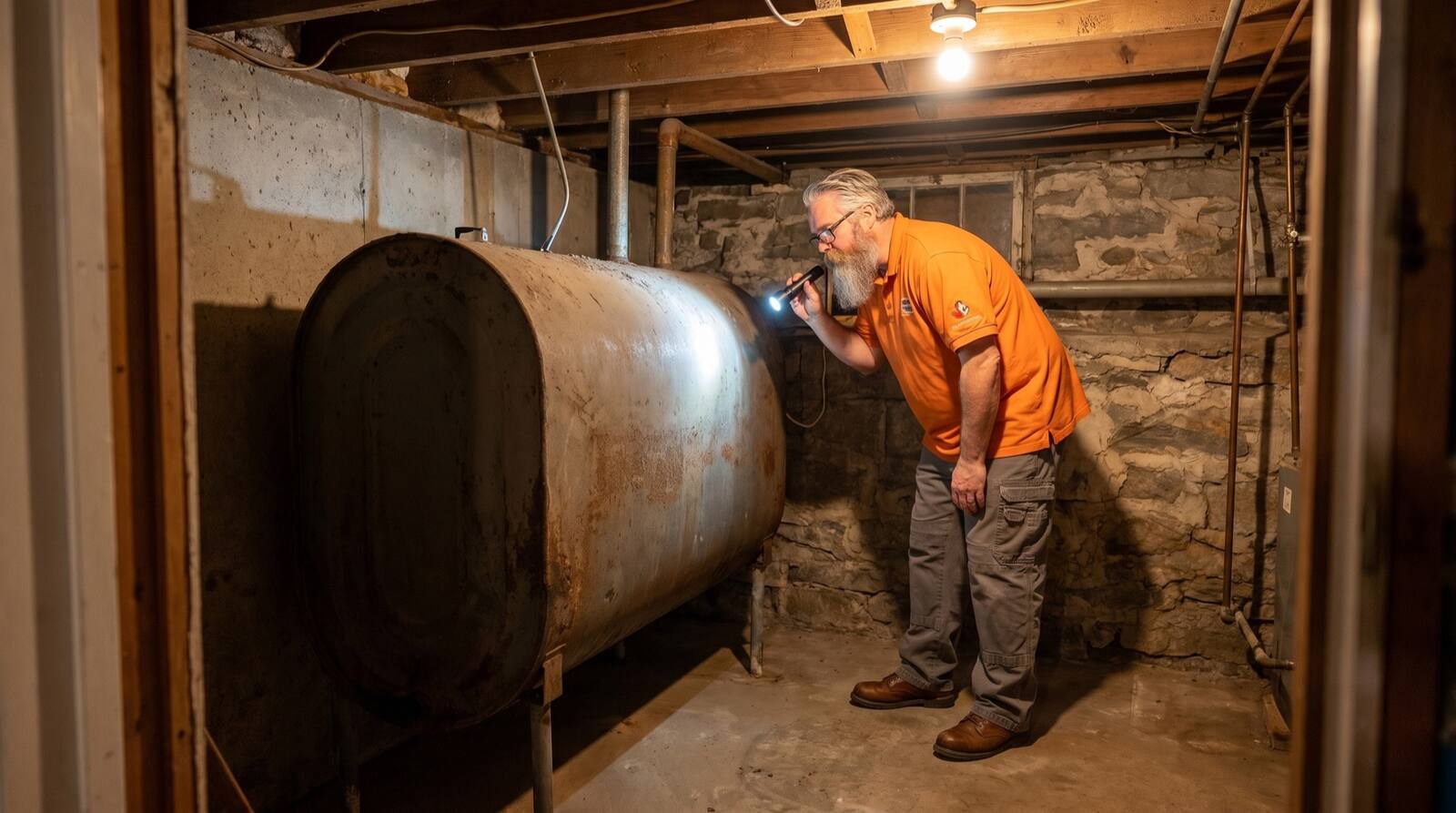
Oil heat is part of the housing reality across Southern New Brunswick. Whether you are looking at a 1960s ranch in Hampton, a heritage home in uptown Saint John, or a Kennebecasis Valley new build, the oil tank you inherit affects insurance, closing, and your first year of ownership in ways that catch buyers off guard. Here is what I look at on every inspection, and what your insurer is going to ask before they issue a policy.
Quick Answer
A standard home inspection includes a visual check of your oil tank’s condition, age, and supply lines. Most insurers require exterior tanks to be replaced after 15 years. Replacement runs $3,000 to $5,000+ in Southern New Brunswick, but New Brunswick homeowners can convert to a heat pump for as little as $0 through SaveEnergyNB programs. If you are buying a home with oil heat, understanding the tank’s condition before closing protects your budget and your insurance coverage.
Why This Matters
Oil heat is still the most common heating system I see across Saint John, Hampton, Rothesay, Quispamsis, and Sussex. A large number of homes built between the 1950s and 1980s in Southern New Brunswick were designed around oil furnaces, and many are still running on those original systems. In 2,000+ inspections, I have seen every stage of oil tank condition, from brand new installations to tanks that were actively leaking into the soil beside the foundation. The condition and age of the oil tank in a home you are buying is not a background detail. It affects your insurance, your closing timeline, and what you are going to spend in the first year of ownership.
This guide covers what I check on every oil tank, what your insurer will ask about, what a replacement costs in Southern New Brunswick, and what your options are if you want to switch to a heat pump.
1. Why Oil Heat Is Still So Common in Southern New Brunswick
Natural gas is not available across most of Southern New Brunswick. Unlike parts of Ontario or Western Canada where gas furnaces are the default, homes in the Saint John area, the Kennebecasis Valley, and the surrounding rural communities were built with oil heating because that was the practical option. It still is for many homeowners.
That is not a problem. Oil heat works. A well maintained oil furnace with a properly installed tank is a reliable heating system. What matters is the condition of what is in the basement or sitting beside the house.
Here is how the system works for buyers who have never encountered one. The oil tank stores heating fuel, typically 200 to 1,000 litres depending on the tank size. A supply line runs from the tank to the oil furnace or boiler. The furnace burns the oil to produce heat, which is distributed through the home via ductwork or baseboards. A fill pipe on the exterior of the home is where the fuel delivery company tops up the tank.
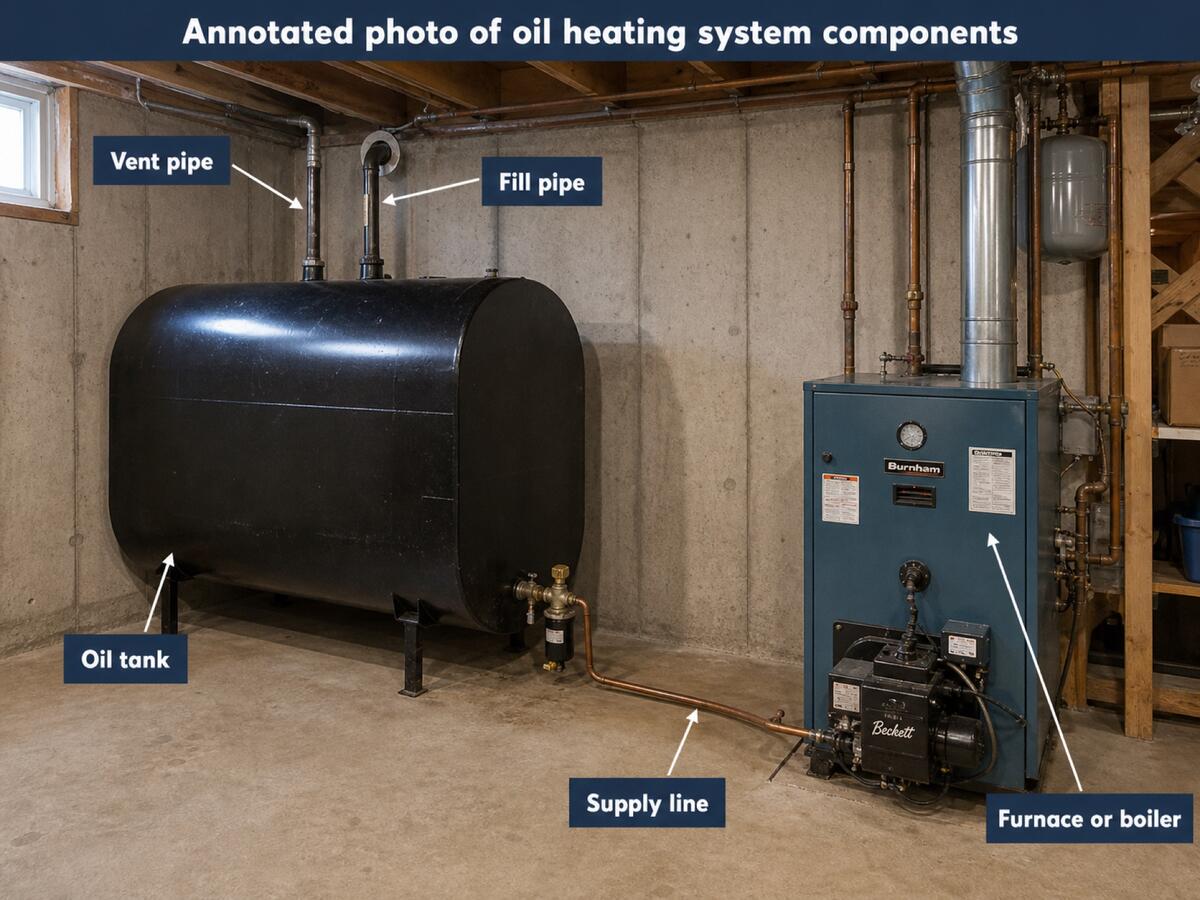
The system itself is straightforward. The variables that matter for a buyer are the age and condition of the tank, the state of the supply lines, and whether the home has ever had a buried tank that was decommissioned but not removed.
2. What I Check on an Oil Tank During a Home Inspection
During every home inspection where oil heat is present, I do a thorough visual inspection of the tank and the oil delivery system. This is part of the standard inspection. It is not an add-on.
Here is what I look at:
Tank condition. Dents, rust blisters, corrosion on the tank walls, legs, and base. Surface rust is common on older tanks. Deep pitting, bubbling, or flaking is a different conversation.
Tank support. The tank should be sitting on a solid, level concrete pad or stand. Tanks that are leaning, sitting on bare soil, or supported by deteriorating wood are a concern.
Fill and vent pipes. These are the two pipes on the exterior of the home where the fuel truck connects. I check for damage, corrosion, and that the vent alarm (whistle) is functional.
Supply lines. The copper or steel line running from the tank to the furnace. I check for corrosion, damage, and that the shut-off valve is accessible and operational.
Filter condition. A dirty or clogged fuel filter affects furnace efficiency and can indicate sludge buildup inside the tank.
Signs of leaks. Staining on the floor beneath or around the tank, oil smell stronger than normal, or darkened soil around an exterior tank. These are the findings that change the conversation from maintenance to remediation.
Manufacturer tag. The data plate on the tank tells me the manufacturer, capacity, and manufacturing date. That date is what your insurer is going to ask about.
What I do not do is a destructive inspection of the tank. I am not cutting into walls, opening sealed tanks, or taking soil samples. If I see anything that suggests a deeper issue, whether that is active leaking, buried tank indicators, or a tank well past its expected lifespan, I recommend a follow-up inspection by a certified oil burner mechanic. That is the specialist who can do a full tank integrity check, ultrasonic thickness testing, and vacuum testing.
The home inspection gives you the picture. The specialist gives you the diagnosis when one is needed.
3. The Insurance Question: Tank Age, Type, and What Your Insurer Requires
This is where oil tanks become a real estate transaction issue, not just a maintenance issue.
The Insurance Bureau of Canada publishes general guidelines on oil tank age limits. Most home insurance companies in New Brunswick follow some version of these thresholds:
| Tank Type | Location | Typical Age Limit |
|---|---|---|
| Single wall steel | Exterior (outdoors) | 15 years |
| Single wall steel | Interior (basement) | 20 to 25 years |
| Double wall steel | Exterior or interior | 25 years |
| Fibreglass | Exterior or interior | Up to 30 years |
These are general guidelines. Every insurer sets its own policy. Some are stricter. I have seen insurers require replacement at 10 years on exterior single wall tanks.
Here is what this means for you as a buyer. If you are purchasing a home with an exterior oil tank that is 16 years old, your insurer may refuse to issue a policy until the tank is replaced. No insurance means no mortgage. No mortgage means no closing.
This is not hypothetical. It happens in Southern New Brunswick regularly. The seller may not know the tank’s age. The buyer may not think to ask. The issue surfaces during the insurance application, days before closing, and suddenly the transaction is in trouble.
A home inspection report that includes the tank’s age, type, and condition gives your insurer exactly what they need. It also gives you and your real estate agent the information to negotiate a replacement credit if the tank is nearing or past the limit.
Double wall tanks are worth noting. A double wall tank has a secondary containment shell around the primary tank. If the inner wall develops a leak, the outer wall catches it before oil reaches the floor or soil. These tanks cost more upfront but last longer, satisfy most insurers for up to 25 years, and reduce your remediation risk significantly.
4. Buried Oil Tanks: The Risk You Cannot See
Homes built before 1980 in Southern New Brunswick may have had underground oil tanks that were decommissioned when the home switched to a new above ground tank or a different heating system. The problem is that “decommissioned” sometimes meant the tank was pumped out and left in the ground. Not removed. Not tested for leaks. Just abandoned.
A buried oil tank that has been sitting in NB soil for 30 to 50 years can corrode, crack, and leak petroleum into the surrounding soil and groundwater. You will not see this from the surface. It will not show up in a standard home inspection. And under New Brunswick law, the property owner is responsible for the cleanup regardless of when the tank was installed or who owned the home at the time.
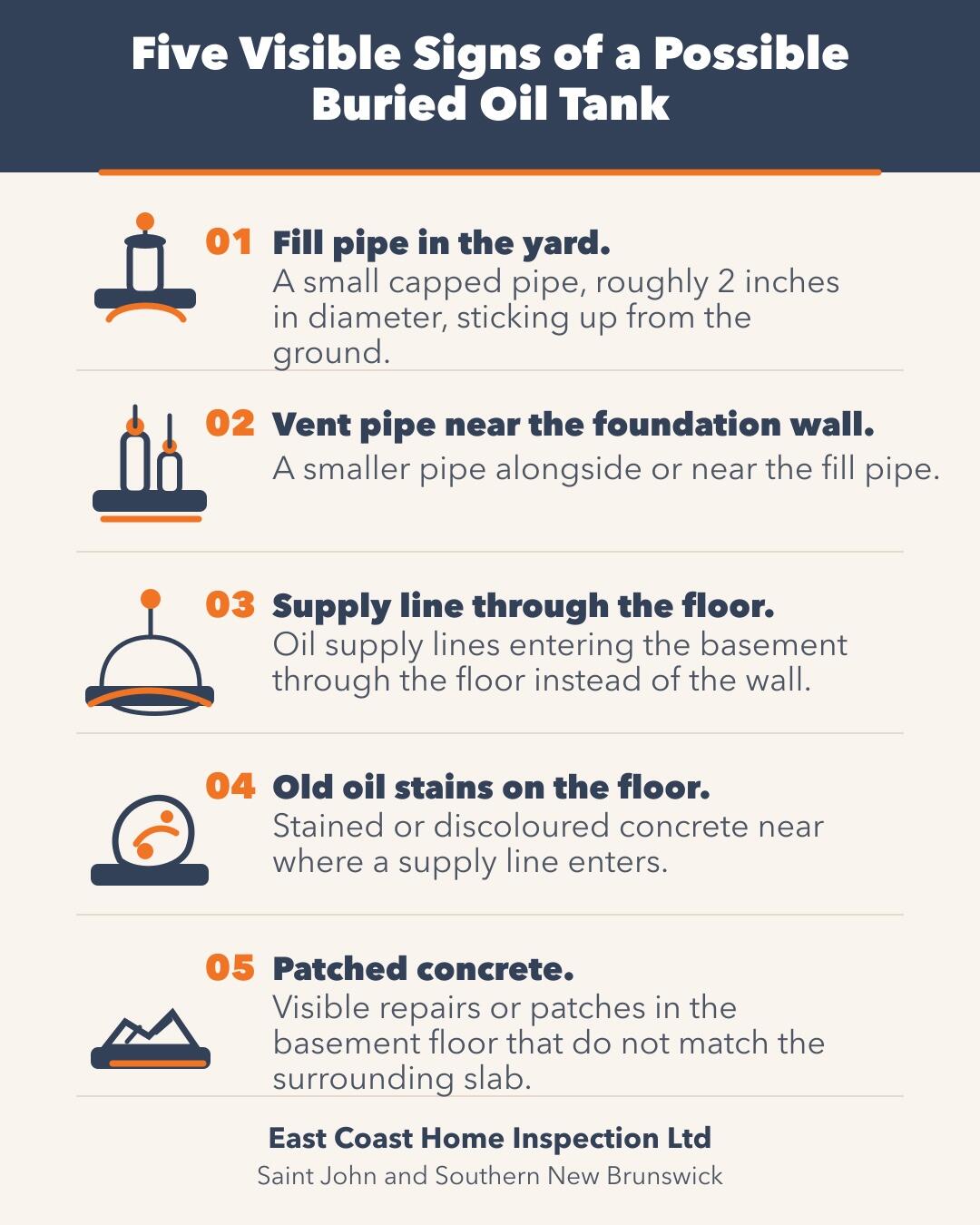
If any of these are present, I note them in the report and recommend a follow-up investigation. A utility locating company can use ground penetrating radar (GPR) to scan the yard for buried objects without digging. This is non destructive and typically costs $300 to $600 in the Southern New Brunswick area.
The Government of New Brunswick maintains a Contaminated Sites Program that outlines homeowner responsibilities for petroleum spills and leaks. Under NB regulation, the property owner is legally responsible for any petroleum storage system on their property, including systems installed by previous owners. That responsibility includes reporting any suspected spills to the Department of Environment and Local Government and funding the cleanup.
5. What an Oil Tank Replacement Costs in Southern New Brunswick
If the home you are buying needs a new oil tank, here is what to budget. These are current ranges for the Southern New Brunswick market, not national averages.
| Work | Cost Range |
|---|---|
| Above ground tank replacement (supply + install by licensed installer) | $3,000 to $5,000+ |
| Old tank removal and disposal (often included in replacement) | $300 to $800 |
| Underground tank removal | $5,000 to $15,000+ |
| Soil testing after underground tank removal | $500 to $1,500 |
| Remediation if soil contamination found | $10,000 to $100,000+ |
| GPR scan for buried tank detection | $300 to $600 |
All oil tank installation and removal work in New Brunswick must be performed by a licensed petroleum tank installer under the Petroleum Product Storage and Handling Regulation. This is not optional. A homeowner cannot legally install or remove their own oil tank. Ask the installer for their licence number before signing.
The wide range on remediation costs reflects the reality. A small spill caught early where the tank was sitting on a concrete pad might require removing a few cubic metres of soil. A buried tank that has been leaking slowly for decades can contaminate a large area and affect neighbouring properties. In the worst cases, remediation can include replacing the foundation, treating groundwater, and compensating neighbours. This is the scenario that makes buried tank detection worth the $300 to $600 investment.
For above ground replacement, the process is straightforward. A licensed installer removes the old tank, installs the new one on a proper concrete pad, connects the supply lines, and disposes of the old tank. Most installers in the Saint John and Hampton area can complete this in a day. Factor it into your offer if the home inspection reveals a tank at or past its age limit.
6. The Conversion Option: Oil to Heat Pump Programs in New Brunswick
If the home you are buying has oil heat and you are thinking about converting, New Brunswick currently has some of the strongest incentive programs in the country. This is not a distant future possibility. These programs are active, funded, and available right now.
The Government of Canada and the Province of New Brunswick fund the Oil to Heat Pump Affordability Program through NB Power. It is designed specifically to help homeowners switch from oil heating to energy efficient heat pumps. The programs are administered through SaveEnergyNB.
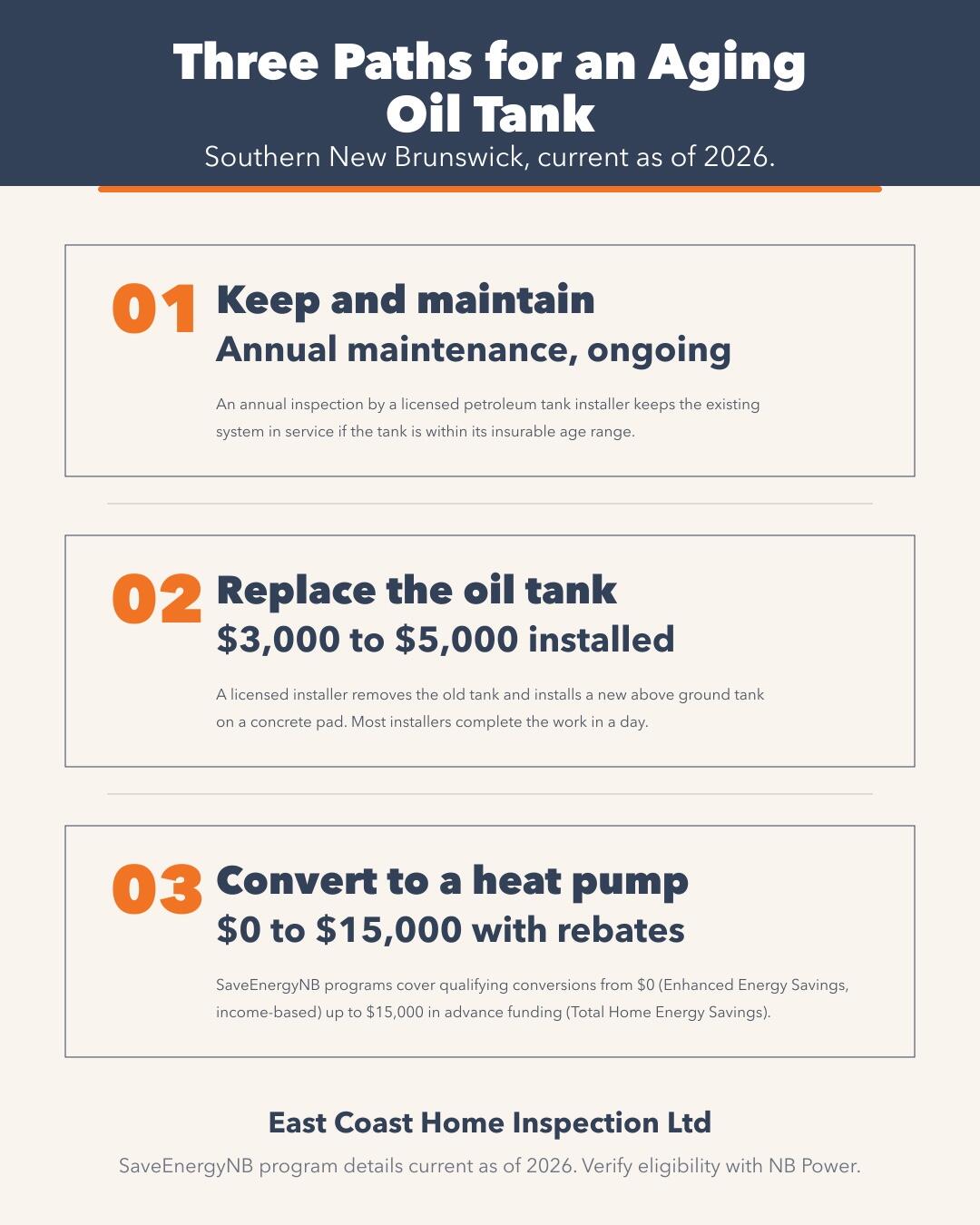
The program is currently active and funded. It is administered by NB Power through SaveEnergyNB. Eligibility is based on household income and the requirement that you are switching from oil as your primary heating source.
What this means for a buyer looking at a home with an aging oil tank: the tank replacement cost of $3,000 to $5,000 might not be the right comparison. The conversion cost, after rebates and funding, could be comparable or lower, and you end up with a modern, efficient heating system instead of a new version of the old one.
I am not here to tell anyone what heating system to choose. That depends on the home, the budget, and the owner’s preferences. But I want every buyer to know these programs exist before they make a decision. Too many people do not find out until after they have already paid for a new oil tank.
7. What to Ask Before You Close on a Home with Oil Heat
If you are buying a home with oil heating in Southern New Brunswick, here is a checklist of questions to answer before you sign. Some of these your home inspector will cover. Others require asking the seller or checking with your insurer directly.
How old is the oil tank? Check the manufacturer’s data plate on the tank. If nobody can find it or read it, that is a red flag worth investigating.
Is the tank single wall or double wall? Double wall tanks have a longer insurable life and lower leak risk. Single wall exterior tanks are the most common age related replacement.
Where is the tank located? Interior tanks (basement) are protected from weather and typically last longer than exterior tanks exposed to rain, snow, and temperature cycles.
When was the tank last inspected by a certified installer? Annual inspections by a licensed petroleum tank installer are recommended by the Government of New Brunswick. If the tank has not been professionally inspected, that is worth factoring into your planning.
Has your insurer confirmed coverage with this tank? Do not assume. Contact your insurer with the tank’s age, type, and location before you finalize the purchase. Ask specifically what their age threshold is.
Has the property ever had an underground tank? Ask the seller directly. If the home was built before 1980 and currently has an above ground tank, there may have been an earlier buried system.
Is the seller willing to provide a certified tank inspection before closing? If the tank is approaching its age limit, a professional tank inspection before you commit protects both parties.
Concerned about something in this article?
Worried about an aging oil tank, radon, mould, knob and tube, sewer issues, or anything else you read here? Take the quiz and I will recommend the right inspection package for your specific situation.
Find My PackageFrequently Asked Questions
Does a standard home inspection include the oil tank?
Yes. Every home inspection I do includes a visual check of the oil tank, supply lines, fill and vent pipes, and the oil furnace. I document the tank’s age, condition, type, and location in the report. If anything indicates a need for further evaluation, I recommend a follow-up by a certified oil burner mechanic.
How do I find out how old my oil tank is?
Check the manufacturer’s data plate, which is typically a metal tag or sticker on the side of the tank. It lists the manufacturer, capacity, model number, and date of manufacture. If the plate is missing, corroded, or unreadable, a licensed installer can often estimate the tank’s age based on its design and construction.
Can I get home insurance with an old oil tank?
It depends on your insurer and the tank’s type and location. Most insurers follow the Insurance Bureau of Canada’s general guideline of 15 years for exterior single wall tanks and 20 to 25 years for interior tanks. Some are stricter. Contact your insurer directly with the tank details before you commit to the purchase.
What happens if my oil tank leaks after I buy the house?
Under New Brunswick law, the property owner is responsible for the cleanup and remediation of any petroleum spill or leak on their property. This applies regardless of when the tank was installed or who owned the home previously. Remediation costs can range from a few thousand dollars for a minor surface spill to $50,000 or more for significant soil and groundwater contamination.
Is it worth converting from oil to a heat pump in New Brunswick?
For many homeowners, yes, especially with the current SaveEnergyNB programs. Households under $70,000 income can convert at no cost. Others can access up to $15,000 in advance funding. The program covers the heat pump, electrical upgrades, and oil tank removal. These programs are currently active and funded.
Do I need a separate oil tank inspection, or is the home inspection enough?
For most transactions, the home inspection gives you a clear picture of the tank’s age, condition, and any visible concerns. If the tank is near or past its age limit, showing signs of corrosion, or there are indicators of a buried tank, I recommend a follow-up with a certified oil burner mechanic for ultrasonic testing and a full integrity evaluation. Think of it as the same approach you would take with a specialist referral after a medical checkup.
Who is responsible for removing an old oil tank, the buyer or the seller?
That is a negotiation between the buyer and seller, and your real estate agent is the person you want in your corner for that conversation. What the inspection report provides is the factual basis for the negotiation: the tank’s age, condition, estimated replacement cost, and any concerns. Some sellers provide a credit. Some replace the tank before closing. The approach depends on the market, the property, and the terms of the agreement.